

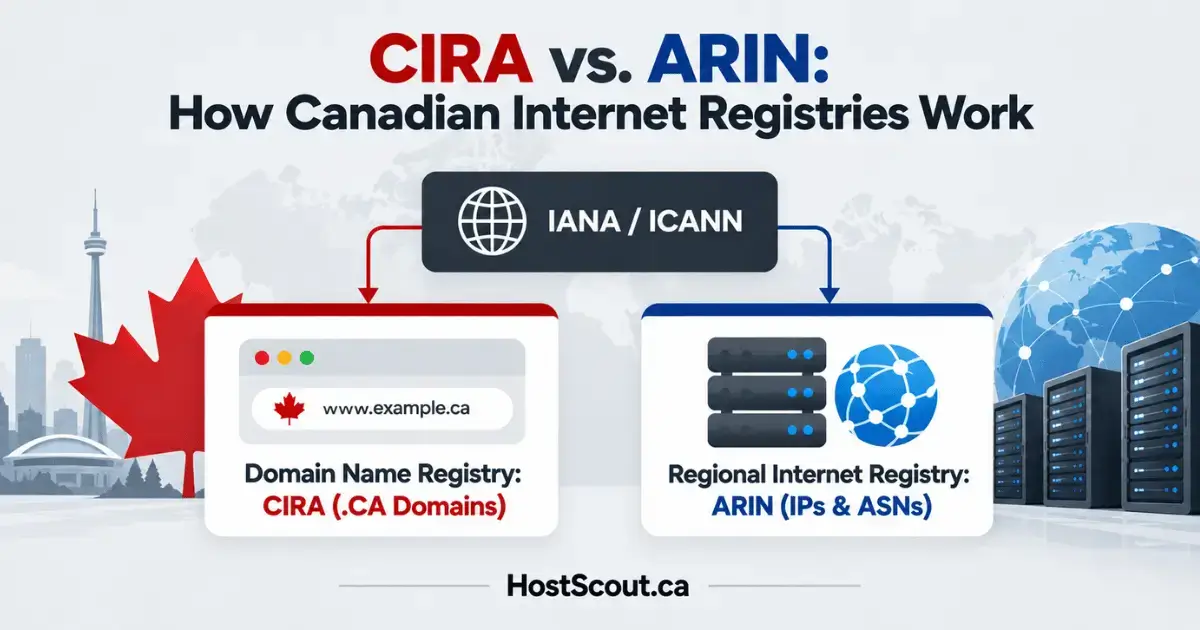
The Short Answer: CIRA Handles Names, ARIN Handles Numbers
When I look into a hosting company, I usually start with two questions: who controls the domain name, and whose network is serving the traffic? Those sound similar, but the records come from different places.
The Canadian Internet Registration Authority (CIRA) operates Canada's .ca domain registry. The American Registry for Internet Numbers (ARIN) administers IP address space and Autonomous System Numbers (ASNs) for Canada, the United States and much of the Caribbean and North Atlantic region. ARIN's American name does not make a Canadian ASN a US-registered business by default. IANA's number-resource directory places Canada explicitly in ARIN's service area.
.CA?CIRARegistry of Canadian domain names
Regional Internet number registry
One for each global service region
Neither a Canadian domain registration nor a Canadian network registration is a certificate proving that your web server, database and backups are physically in Canada. That's why HostScout investigates ownership, routing and facilities separately when evaluating Canadian-owned web hosting companies.
The Two Trees of the Internet: ICANN, IANA and PTI
The global coordination layer is often reduced to one vague sentence saying “ICANN runs the internet.” I think it's easier to understand by separating the identifiers from the organizations that operate the networks.
ICANN coordinates the internet's global unique-identifier systems. The IANA functions maintain technical registries for DNS root-zone names, number resources and protocol parameters. Since 2016, those functions have been performed by Public Technical Identifiers (PTI), an ICANN affiliate. They do not directly sell your domain, issue every Canadian IP address or operate your website. ICANN's PTI definition explains that operational relationship.
Below that global coordination layer, the responsibilities divide into two paths:
- The names path. The DNS root leads to top-level domain registries.
- For a
.caname, that registry is CIRA. - The domain registrar or reseller handles the customer-facing registration.
- For a
- The numbers path. The IANA number-resource functions allocate resources to Regional Internet Registries.
- For Canada, the relevant RIR is ARIN.
- Network operators use registered IP addresses and ASNs to operate and interconnect networks.
These are two branches of the same internet, not two separate systems competing to manage your website.
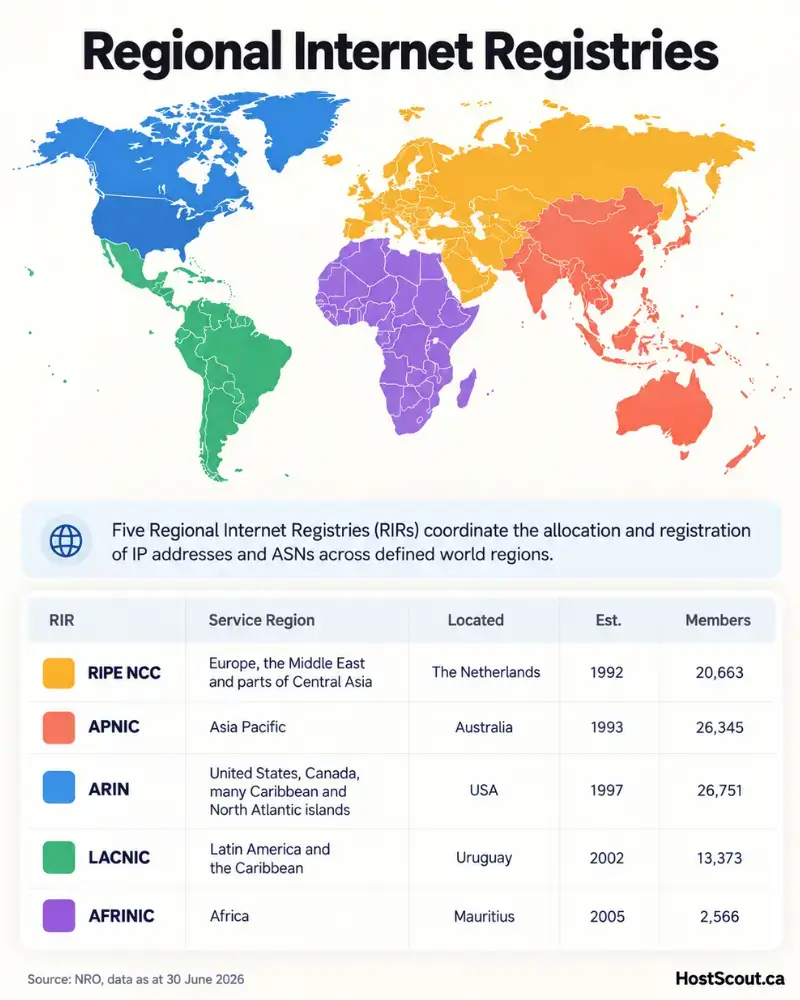
The Five Regional Internet Registries and Where Canada Fits
IANA allocates pools of Internet number resources to five Regional Internet Registries (RIRs). Each RIR follows policies developed in its own service region and registers resources held by network operators. It doesn't mean the addresses can only be routed or used inside those borders.
| Registry | Service region | What to remember |
|---|---|---|
| ARIN | Canada, United States, parts of the Caribbean and North Atlantic | Canada's number registry |
| RIPE NCC | Europe, Middle East and Central Asia | Not Canada's default RIR |
| APNIC | Asia-Pacific | Includes some national registry arrangements |
| LACNIC | Latin America and parts of the Caribbean | Caribbean coverage is split with ARIN |
| AFRINIC | Africa region | Africa's regional number registry |
All five are listed in IANA's official RIR overview. The important Canadian takeaway is that ARIN covers Canada, while its Caribbean coverage is shared geographically with LACNIC.
Why are IPv4 addresses harder to obtain now?
The IPv4 shortage is easier to understand as three separate facts:
- New IPv4 allocations are limited. IANA's ordinary free pool was exhausted in 2011, but that did not make existing IPv4 addresses disappear.
- Addresses can still change hands. Regional registries manage returned address space, transfers and policy-driven requests. ARIN also maintains an IPv4 waiting list.
- IPv6 provides room for growth. Networks can expand with IPv6 resources, which are also administered through the RIR system.
For a Canadian business buying hosting, this is mostly background. Your host can give you an IP address from its own inventory without you applying to ARIN yourself.
How a Canadian Network Gets an ASN or IP Addresses
ARIN has served Canada since its formation in December 1997. A network that needs its own directly registered number resources generally works with ARIN. The organization creates a registry identity, documents its request and follows the applicable resource policies and agreements.
When I examine a Canadian ARIN record, I separate the evidence it provides from the details it cannot confirm:
- Registered organization. Canadian Org ID applicants must provide a tax identifier such as a CRA Business Number or Quebec Enterprise Number (NEQ). ARIN's Org ID procedure explains the requirements.
- Supporting documentation. ARIN may examine other corporate records when reviewing an organization.
- Limits of the record. An Org ID does not, by itself, establish beneficial ownership, who owns the physical equipment or where customer data is processed.
No. Canada does not have a National Internet Registry (NIR) layer between ARIN and Canadian operators. Some countries in the APNIC and LACNIC regions use NIR arrangements, but CIRA is not one of them. CIRA manages .CA names, not Canada's IP allocations.
Most businesses do not need a standalone ASN. They use address space and routing supplied by their ISP, cloud platform or host. An organization running independent routing, multihoming or direct peering may have a different reason to request its own ASN. For a real verification workflow, see how I verify a Canadian ASN using ARIN and BGP, including why a registered Canadian network is not automatically a Canadian data centre.
The Domain Name Chain: Registry, Registrar and Reseller
On the names side, the terms sound almost identical but mean different things. The registry operates a top-level domain database. A registrar has the necessary agreement or accreditation to register names for customers. A reseller can sell registrations through that registrar without its own direct accreditation for the particular TLD.
CIRA for .CA
CIRA runs the .CA namespace and administers its rules, including Canadian Presence Requirements. It does not sell ordinary registrations directly to customers.
Verisign for .COM
Verisign operates the .COM registry under its agreement with ICANN. That does not require .COM websites to be hosted in the United States.
WHC, IANA ID 938
ICANN lists WHC Online Solutions Inc. as an accredited registrar with identifier 938. A registrar's identifier is not an ASN.
Hosting agency or reseller
An agency may take your payment and manage renewals through a registrar's reseller platform. The sponsoring registrar remains the direct registry-facing organization.
You can verify the WHC example in ICANN's accredited registrar list. ICANN registrar accreditation covers generic TLDs; .CA registrars also operate under CIRA's certification and registry rules. Buying a .CA through a hosting reseller doesn't change which organization runs the .CA registry.
On an actual website, I also check who plays each role. They may all be different legal entities:
- Domain registrant: holds the registration rights for the domain name.
- Registrar: sponsors and maintains that domain registration with the registry.
- Hosting provider: operates or supplies the servers and related services.
- Network operator: holds or announces the IP addresses used to route traffic.
Keeping those roles distinct helps me identify what a hosting company's claims actually prove.
How the Two Registry Chains Fit Together
This is the diagram I use to explain the difference to someone who has never worked with registry records. The two columns sit beneath the same global identifier-coordination system, but they answer different questions.
ICANN / PTI performing IANA functions
DNS root identifiers and global IP / ASN resource pools
The .CA naming path
- 01CIRA registry
Maintains .CA rules and the domain registry
- 02Certified registrar
Registers the name and submits changes to CIRA
- 03Reseller, if used
Provides a retail storefront or account management
- 04Domain registrant
Controls the registered name and its DNS delegation
The Canadian number path
- 01ARIN
Registers number resources for Canada and its wider region
- N/ANo Canadian NIR
Canada does not add a national number-registry tier
- 02Network operator or ISP
Holds or uses IP address space and may operate an ASN
- 03Website infrastructure
Runs on addresses announced by one or more networks
The authoritative DNS service publishes addresses for a hostname. Those IP addresses have their own registry and routing records. Looking up one does not automatically verify the other.
What Connects Domain Names to Internet Numbers?
When you visit a website, DNS resolution and IP routing work together. But the registry records have different owners, and the connection is more precise than saying that ARIN somehow tells CIRA where the website lives.
Forward DNS
A hostname's A or AAAA record points to an IP address. Its authoritative DNS provider may be a third party. The address can later be inspected in ARIN RDAP or another RIR's records.
Glue records
When a nameserver is inside the domain it serves, its parent zone may need A or AAAA glue records to avoid a circular lookup. Glue is not the website's hosting-location certificate.
Reverse DNS
PTR lookups use in-addr.arpa for IPv4 and ip6.arpa for IPv6. Reverse delegations follow IP-address administration and are commonly configured by the address holder or provider.
RDAP
RDAP provides structured registration data. The .CA domain registry and ARIN's number registry each publish records, but for different object types: domain names versus IP networks and ASNs.
For example, example.ca could use a nameserver operated by one company, resolve to a CDN edge run by another, and have its origin hosted by a third. You have to check the actual IP address and routing to understand which network you're measuring.
Email administration is a good example of why the two paths matter:
- MX records belong to the domain's forward DNS zone. They identify the mail systems that receive messages for that domain.
- PTR records are part of reverse DNS for the mail server's IP address. The IP address holder or provider commonly controls the required changes.
Transferring a domain to another registrar does not, by itself, fix a provider-controlled PTR record.
Why a .CA Domain Can Still Route to the United States
CIRA's Canadian Presence Requirements identify who can register a .CA name. They do not impose a blanket rule that the website, nameservers, CDN, email or backups must be in Canada. Conversely, a .COM domain can be served from Canadian-owned infrastructure inside Canada even though its registry operator is US-based.
.CA name, foreign infrastructure
A Canadian company meets CIRA's eligibility requirements but uses a US-hosted website or a global CDN. The domain remains legitimately .CA.
.COM name, Canadian infrastructure
A business registers a .COM name through an accredited registrar, then uses a Canadian host with Canadian-operated equipment. Its TLD does not force hosting abroad.
For any claim that a website is “hosted in Canada,” I separate the evidence into four checks:
- Domain eligibility: who is allowed to register the name?
- Registry and network identity: who holds the IP addresses and ASN?
- Infrastructure location: where do the website and supporting services actually run?
- CDN visibility: does the public IP point to the original server or only to a proxy network?
That separation is central to my guide to data residency versus data sovereignty. A public IP test is a useful clue, but a CDN can hide the original hosting server.
French Accents Are a Domain Registry Feature, Not an IP Feature
Here's another Canadian example that makes the names-versus-numbers distinction concrete. CIRA supports a defined set of 16 French accented characters and ligatures in .CA domain names. They are internationalized domain names, or IDNs, with an ASCII-compatible form called Punycode.
For instance, the readable name façon.ca is represented as xn--faon-1oa.ca in the DNS. That transformation concerns the domain label, not which regional registry allocates the server's IP address.
If you're choosing a French-language domain for a Québec business, my French accent to Punycode converter will show how names are encoded. For registration rules and reserved accent variants, see the companion guide to French-accented .CA domains.
How I Check a Canadian Website in Practice
Rather than relying on a domain extension or a provider's “Canadian” badge, I do a quick sequence of checks. Each answers a different question, and each has limitations.
-
Identify the domain registrar.
Start with the domain registration details.
- Record the sponsoring registrar and any public information about the registrant.
- Remember that CIRA runs the
.caregistry but may not be the company billing the customer.
-
Resolve the active hostname.
Check what the domain currently points to.
- Inspect its
A,AAAAand nameserver records. - Use Is It Hosted in Canada? for an initial look at the public-facing IP location.
- Inspect its
-
Inspect the IP network and ASN.
Identify the organization associated with the address you found.
- Check its registered operator using the ARIN WHOIS and ASN lookup tool.
- Compare the registration with the current BGP route rather than assuming the registry record proves where a server sits.
-
Check what those records cannot show.
Finish with the evidence that DNS and routing records alone cannot establish.
- Investigate CDN proxies, actual origin location and data-centre tenancy.
- Review corporate ownership, backups and contractual processing locations where those details matter.
dig +short NS example.ca
dig +short A example.ca
dig +short AAAA example.ca
# Replace example.ca with the website you are auditing.
My broader hosting verification tools page brings those public checks together, while the Canadian ASN verification guide goes deeper into Org IDs, BGP, transit, peering and false conclusions about server geography.
Not a single “Canadian” checkmark. I want to know who registered the name, who controls the network addresses, where the service actually runs and how confident each observation makes me. That's a much more useful way to judge hosting claims.
ARIN’s Region: Where Canada's Internet Number Registry Serves
Canada is one part of a much larger ARIN service region. I include the full list because it explains why an ARIN record can legitimately be associated with a network outside Canada. In other words, ARIN registration alone is not a Canadian-location test.
The table below follows ARIN's official list of countries and geographical areas. It contains 29 entries, including some remote islands and territories. These are administrative service-region designations, not claims that ARIN has offices, servers or operational network equipment in each place.
Complete List of Countries or Geographical Areas in the ARIN Region
| Country / Geographical Area | A2 | A3 |
|---|---|---|
| Anguilla | AI | AIA |
| Antarctica | AQ | ATA |
| Antigua and Barbuda | AG | ATG |
| Bahamas | BS | BHS |
| Barbados | BB | BRB |
| Bermuda | BM | BMU |
| Bouvet Island | BV | BVT |
| Canada | CA | CAN |
| Cayman Islands | KY | CYM |
| Dominica | DM | DMA |
| Grenada | GD | GRD |
| Guadeloupe | GP | GLP |
| Heard and McDonald Islands | HM | HMD |
| Jamaica | JM | JAM |
| Martinique | MQ | MTQ |
| Montserrat | MS | MSR |
| Puerto Rico | PR | PRI |
| Saint Barthelemy | BL | BLM |
| Saint Helena | SH | SHN |
| Saint Kitts and Nevis | KN | KNA |
| Saint Lucia | LC | LCA |
| Saint Martin | MF | MAF |
| Saint Pierre and Miquelon | PM | SPM |
| Saint Vincent and The Grenadines | VC | VCT |
| Turks and Caicos Islands | TC | TCA |
| United States | US | USA |
| United States Minor Outlying Islands | UM | UMI |
| Virgin Islands (British) | VG | VGB |
| Virgin Islands (U.S.) | VI | VIR |
The A2 and A3 columns are country or area identifiers. They are not ASN numbers, IP address prefixes or data-centre locations.
For a Canadian website audit, the useful next step is still to look at the specific registered ASN or IP address and then examine the actual route, provider and hosting arrangement. The country list explains ARIN's jurisdiction, not where every workload runs.
Frequently Asked Questions
Who manages IP addresses and ASNs in Canada?
ARIN is Canada’s Regional Internet Registry. It administers registration and distribution of IPv4 addresses, IPv6 addresses and Autonomous System Numbers for its service region, including Canada. Canadian networks can also use resources supplied by upstream providers.
Who runs the .CA domain registry?
The Canadian Internet Registration Authority (CIRA) operates the .CA country-code domain registry. It manages the namespace and rules, while CIRA-certified registrars sell registrations to eligible customers.
Is CIRA a domain registrar or a registry?
CIRA is the .CA registry, not the retail registrar. People register .CA names through certified registrars or their resellers. CIRA itself does not sell the registrations directly.
What are the five Regional Internet Registries?
They are ARIN, RIPE NCC, APNIC, LACNIC and AFRINIC. Each administers Internet number resources for a defined service region. Canada is in the ARIN region.
Does a .CA domain have to use servers located in Canada?
No. A .CA domain has eligibility rules for its registrant, not a requirement that its website, DNS servers or email infrastructure be in Canada. A .COM site can also be entirely hosted in Canada.
Does Canada have a National Internet Registry?
Canada has no separate National Internet Registry tier for Internet number resources. Operators requesting their own resources normally work with ARIN, while many sites and businesses use their provider’s assigned addresses.
Why I Keep the Two Registries Separate
When I review a Canadian hosting claim, I keep three pieces of evidence separate:
- CIRA and the domain name: what the
.caregistration tells me about eligibility and registration. - ARIN and the network: what the number-resource record tells me about the registered organization and its addresses or ASN.
- BGP and observed routing: how a network is advertising a route, without treating that observation as proof of physical hosting location.
For a Canadian website owner, you don't have to manage these registries yourself. But knowing where the records originate makes it much easier to ask a host the right questions and spot when an answer is really about a domain, rather than a server or network.
Research reviewed October 24, 2026. Registries, providers and infrastructure can change. This is technical guidance for independent verification, not a certification of any service or legal advice.