

What a Canadian ASN Can Actually Tell You
When I check a Canadian web host, I rarely start with its “Canadian servers” badge. I start with the network records. An autonomous system number, or ASN, can identify the organization responsible for an Internet routing system. It gives me a way to compare a hosting company's claims with a public technical record.
That doesn't make an ASN a certificate of Canadian ownership. The record tells me who registered a network resource. I still need to check the business behind it, whether the network is currently visible in BGP, and where the actual hosting equipment operates.
To verify a Canadian ASN, look up its ARIN organization and Org ID, confirm the registered country, examine live BGP routes, and cross-check company and facility records. One matching field is useful evidence. Several independent matches tell a much stronger story.
You can follow along with my ARIN Whois and ASN lookup tool. I'll use real records from the HostScout hosting reviews, including a Cloudflare example where the public-facing ASN gives the wrong impression about the origin infrastructure.
Canadian ASN Quick Facts
A number of old websites quote around 1,600 “active Canadian ASNs.” That figure is not a reliable 2026 count without a named BGP dataset, a measurement date and a definition of active. I prefer IANA's published country allocation summary for an attributable registry figure, while keeping it distinct from networks visible in the global routing table.
What an ASN Is, Without the Networking Jargon
Think of a website's IP address as a street address. An ASN is closer to the identifier for the road network that advertises how to reach a collection of addresses. Internet operators exchange these routing announcements through the Border Gateway Protocol (BGP).
A company might operate its own ASN and connect to several carriers. Another company might rent servers and IP addresses from a larger network without having an ASN at all. Both can sell hosting. Their infrastructure control, however, is not the same.
The address of a particular network interface or endpoint.
An identifiable routing policy under an ASN.
An organization linked to Internet number resources.
There are two ASN number formats, but they are part of the same global numbering system. A classic 2-byte ASN fits inside the 0 to 65,535 range. A 4-byte ASN extends the space through 4,294,967,295. For example, AS271 is in the old range, while AS401665 requires the expanded range. The number's length is not a ranking, a Canadian status flag or a measure of how advanced a provider is.
The important evidence comes from the relationships around that number: resource-holder registration, advertised IP prefixes, upstream connectivity, peering exchanges and the provider's legal and physical footprint.
ARIN vs. CIRA: Who Verifies Canadian Networks?
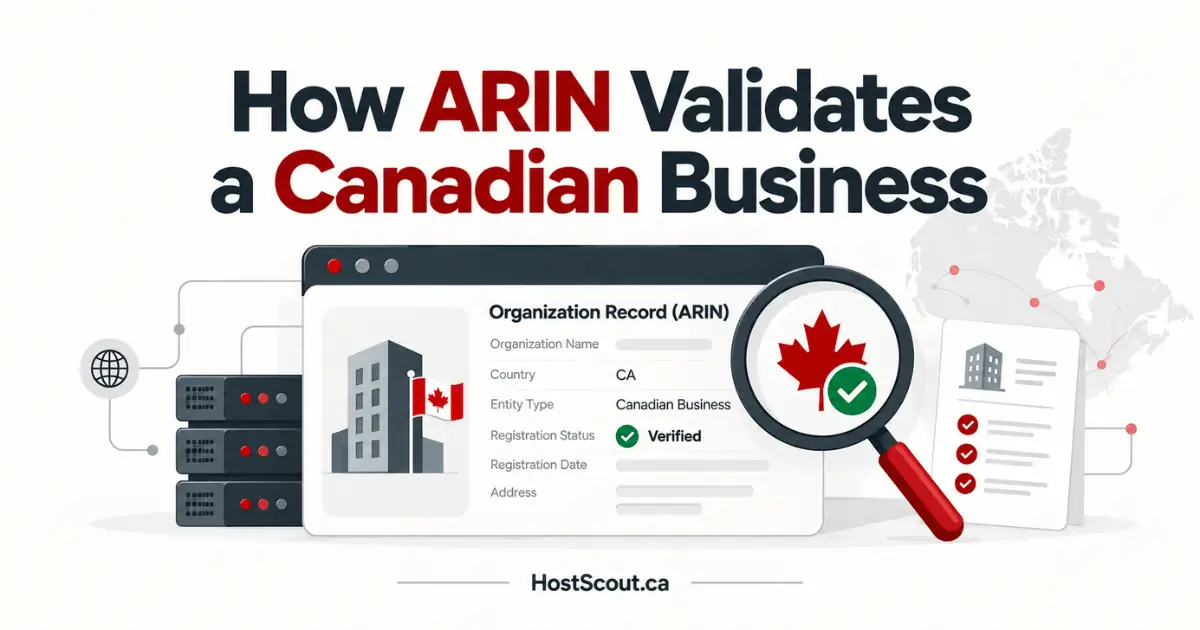
CIRA operates Canada's .ca domain registry. It does not issue Canadian ASNs or IP address allocations. That work generally falls to ARIN, the American Registry for Internet Numbers, one of the world's five regional Internet registries.
ARIN has served Canada since December 1997. Its published Org ID requirements contain a detail I think every Canadian hosting buyer should know: Canadian applicants must provide a tax identification number, for example a Canada Revenue Agency Business Number (CRA BN) or Quebec Enterprise Number (NEQ). ARIN also requires a signed Registration Services Agreement before approving the Org ID and may ask for documentation showing the entity is legally registered.
What the registry process supports
An identifiable organization, administrative contacts, a tax identifier from Canadian applicants and a contractual registration process.
What it does not establish
Canadian shareholders, ownership of data-centre buildings, exclusive ownership of routers, server location or the geographical movement of customer data.
That difference is critical. Supplying a CRA BN or NEQ is not the same as ARIN publicly certifying a company's ownership structure. The number is also not normally displayed in public ASN lookup results, so readers cannot treat the public Org ID alone as evidence that a CRA database cross-check succeeded.
There is another point that surprises people: ARIN's current policy allows one ASN per organization on request. Requesting additional ASNs requires an appropriate technical reason or unique routing-policy justification. It is not an elite badge reserved only for the largest providers.
How a Canadian Company Gets Its Own ASN, and What ARIN Charges
Most small websites don't need their own ASN. Their hosting provider already manages the IP addresses and routing. The picture changes when a business runs a network with an independent routing policy, operates multiple carrier connections or wants to control how its own prefixes are announced.
ARIN's resource request guide allows an eligible organization to request one ASN. Extra ASNs need a specific routing-policy or technical justification. The process is to create an ARIN Online account, establish an Org ID and authorized contact, submit a request, respond to any verification questions, pay the applicable fees and sign the RSA.
The old US$550 ASN issuance fee disappeared in January 2024, when ASN-only holders moved into ARIN's annual Registration Services Plan. This means “an ASN costs $550 upfront plus $150 every year” is outdated. The right amount depends on the combined IPv4, IPv6 and ASN holdings attached to the Org ID. I used ARIN's 2026 fee schedule and its published 2027 schedule for these figures.
Typically, yes, if you intend to establish your own BGP peering sessions. But buying hosting at an exchange-connected data centre does not make you a network operator. Most businesses can use the provider's existing ASN instead.
From BCNET's AS271 to Modern Canadian Hosting Networks
Canadian networks were using autonomous system numbers long before most small businesses had websites. One early example is BCNET's AS271, registered on February 24, 1989. Its role in British Columbia's research and education connectivity is a useful reminder that Canada's Internet infrastructure did not begin with the commercial hosting boom.
BCNET AS271 is an early Canadian ASN on record.
ARIN starts operating as an independent regional Internet registry.
Four-byte ASNs begin their staged adoption to expand numbering capacity.
AS400262 (WHC) and AS401665 (HostBilby) illustrate much newer allocations tied to Canadian hosting operators.
I would not use a low ASN as proof of a better company. Nor would I consider a six-digit ASN suspicious. Some of Canada's longest-running networks have short numbers simply because of when they were allocated.
How to Check if an ASN Is Canadian in Five Steps
Here's the workflow I use when an IT buyer asks whether a hosting company is genuinely operating a Canadian network.
Start with the website or known IP
If you only have a domain, use the Canadian hosting location checker to inspect the public IP and visible ASN. Write down whether the result appears to be a CDN or another intermediary.
Look up the ASN in ARIN
Enter the ASN in my ARIN Whois tool. Check the organization name, Org ID, country, registration date and related handles. The public record identifies a resource holder, not necessarily the operator of every website using that network.
Compare the legal organization
Look for the same legal name in a Canadian corporate registry. A province in an ARIN mailing address is a starting point, not a corporate incorporation certificate. Parent companies and trade names can complicate the match.
Check live routing
Look at originated prefixes and upstreams in a BGP view. Check whether the ASN is visible and whether the prefix really originates there, rather than simply appearing somewhere in an AS path.
Verify the actual service location
Check the provider's documented data-centre city, any relevant facility or peering records, and the contracted service location. An ASN cannot tell you where a particular virtual machine, backup or database sits.
These checks answer different questions. A good audit keeps each piece of evidence separate until the claims line up.
Read a Real ARIN Record: WHC's AS400262
WHC is a useful case study because the company has a registered network identity, while its public website also uses a CDN. ARIN lists AS400262 to WHC Online Solutions Inc., under organization ID WOS-29, with a Montréal registration address. That is a specific, checkable Canadian network record.
This is a simplified summary using identifiers checked against ARIN. It is not a live WHOIS transcript. Recheck the current record before using it in an audit.
ASNumber:   400262
ASName:     WHC
OrgName:    WHC Online Solutions Inc.
OrgID:      WOS-29
City:       Montréal
StateProv:  QC
Country:    CA
RegDate:    2021-11-29

# Registry identity, not a data-centre certificate.
For a developer who wants the underlying data, ARIN exposes a structured RDAP endpoint. This is the modern machine-readable counterpart to older text WHOIS lookups.
curl -L -H 'Accept: application/rdap+json' \
  https://rdap.arin.net/registry/autnum/400262
RDAP can confirm the registered ASN and related entities. It does not prove that AS400262 is currently originating a particular IP prefix. For that, I check a routing collector or a live BGP tool separately.
If the first address you inspect belongs to a CDN, a parked domain or an external DNS provider, you are checking that service's network. You're not necessarily checking the original web host.
Find an ASN from the Command Line
My ARIN lookup is easier when you just want to check a provider. If I need a result in a terminal or troubleshooting notes, I use these read-only commands. The first looks up the registered ASN. The second starts with an IP address and returns a BGP-derived origin ASN.
whois -h whois.arin.net "a 400262"whois -h whois.cymru.com " -v 1.1.1.1"The IP above is a public resolver address used as a demonstration, not evidence about a Canadian host. Replace it with the IP you are investigating. Team Cymru documents that its country code comes from registry data, not proof of where the server is physically located. See the IP-to-ASN service instructions.
On systems without the whois command, install an appropriate WHOIS client first. On Windows, the built-in browser-based lookup or ARIN RDAP can be simpler than adding terminal utilities.
Six Free Tools for ASN and BGP Investigations
I don't use one website for every part of an audit. Different tools answer different questions. These are the resources I would bookmark alongside HostScout's own network checker.
| Tool | Best for | What to watch for |
|---|---|---|
| ARIN RDAP | Registration, Org ID and official contacts | Not live routing or server geography |
| bgp.tools | Visible routes, peers and network relationships | Collector-dependent and time-sensitive |
| Hurricane Electric BGP | Quick ASN, prefix and peering overview | Not an incorporation or location register |
| RIPEstat | Routing history, visibility and diagnostic datasets | Interpret dataset windows and coverage |
| PeeringDB | Declared Internet exchanges and facilities | Some information is supplied by operators |
| IPinfo | IP/ASN association and country-level views | Registry country and IP geolocation differ |
The Cloudflare CDN Illusion: AS13335 vs. AS400262
Consider whc.ca. The website's public DNS can resolve to Cloudflare addresses, whose network is AS13335. Cloudflare's own documentation explains that its proxied DNS records return Cloudflare IP addresses rather than the real origin IP. That is exactly what a CDN is designed to do.
Meanwhile, WHC has a separate ARIN record for AS400262. Those two facts can both be true. A public Cloudflare lookup doesn't tell us where WHC's origin is located, and WHC's registered ASN does not prove the proxied website's hidden origin uses that ASN.
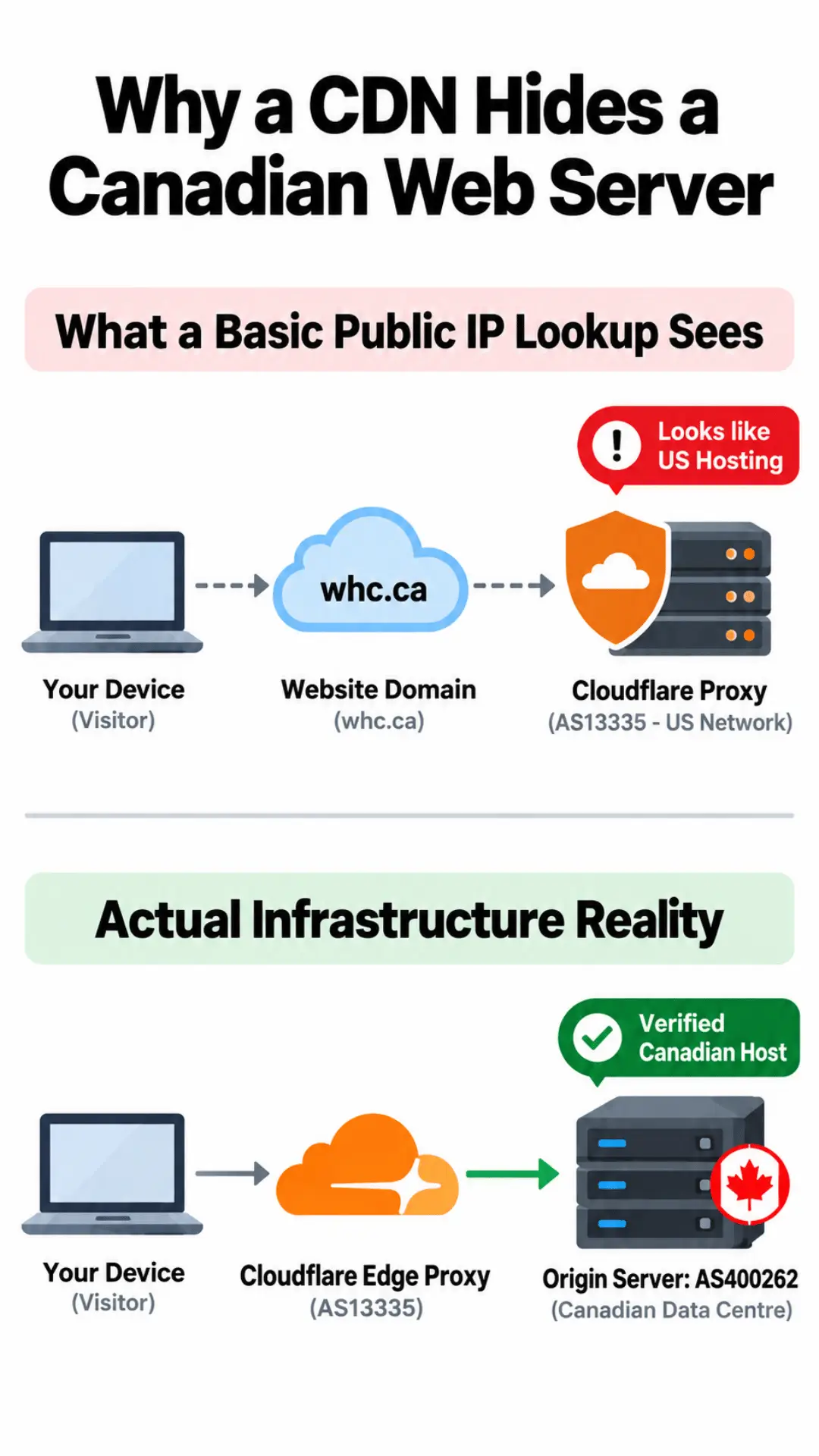
Cloudflare explains this proxy behaviour in its official IP-address documentation. It is why I never label a Canadian website “US hosted” solely because the edge ASN is registered to a US company.
Three Traps That Distort Canadian ASN Lookups
CDN and reverse proxies
The CDN's edge ASN is visible. The origin may be hidden or protected by access rules. This changes the meaning of the lookup, not necessarily the hosting location.
Foreign upstream carriers
A Canadian network can buy transit from a foreign carrier and still operate equipment in Canada. A BGP path that includes an overseas company is not proof that site files or databases are stored abroad.
Colocation and leased infrastructure
A Canadian corporation may route its own address space through equipment installed in a rented data-centre rack. The ASN does not establish who owns the building, router or server hardware.
When I need a stronger conclusion, I check the public registry records, provider statements, traceroutes and physical facility evidence together. I explain those layers in my hosting verification methodology.
Canadian Web Host ASNs: A Reference Table
These ten examples link to my HostScout review library. Most are Canadian-registered network operators; HostPapa AS23273 is a US-registered counterexample. I have kept the registry location separate from the server location, and flagged InCentre’s recent transfer so readers do not confuse a historical Org ID with the current operator.
| Provider / Review | ASN and Org ID | Registered organization / City | What the network evidence means |
|---|---|---|---|
| WHC | AS400262WOS-29 | WHC Online Solutions Inc.Montréal, QC | Registered WHC network. A proxied website may use a different edge ASN. |
| HostBilby | AS401665HOSTB-7 | HostBilby Inc.Hamilton, ON | Canadian registry identity; Toronto infrastructure and peering documented separately. |
| CanHost | AS40438CANHO-2 | Canhost Inc.Kelowna, BC | Own network registration, with Kelowna facility evidence in the review. |
| PlanetHoster | AS53589LEGRO-2 | PlanetHosterLaval, QC | Canadian registry identity; services also operate internationally. |
| Astral Internet | AS394277AI-425 | Astral Internet Inc.Saint-Jean-sur-Richelieu, QC | Canadian-registered network; infrastructure location needs separate verification. |
| GTHost | AS62563GC-152 | GlobalTeleHost Corp.Richmond Hill, ON | Canadian company registry address; advertised server cities include Toronto, Montréal and Vancouver. |
| FullHost | AS39962PNM-15 | FullHost / Pretecs Networks Inc.Victoria, BC | A Canadian-registered provider ASN. Its BGP announcements and published data-centre regions are separate checks. |
| InCentre | AS6171Org ID: recheck after transfer | The Internet Centre Canada Inc.Edmonton, AB; PeeringDB current record | A transfer from WorldGate was reported in October 2026. Older WHOIS mirrors may retain the former name and Org ID. |
| Serv3r | AS400130HS-1009 | Hébergement Serv3r.net inc.Mascouche, QC | Canadian registration for the operator's network; Montréal infrastructure is documented separately. |
| HostPapa | AS23273HOSTP-7 | HostPapaBuffalo, NY, USA (ARIN record) | Useful contrast: the brand has Canadian roots, but this ASN's ARIN organization is US-registered. It is not evidence of a Canadian-registered network. |
Registry names and Org IDs can change after mergers, transfers and record updates. Treat the table as a dated research index, not as a live feed. Use the ARIN lookup to recheck the ASN before using it in procurement or compliance documentation.
What TorIX and ONIX Add to a Network Audit
ARIN tells me a registered network identity. An Internet exchange adds a different kind of evidence: whether a network participates in a place where networks exchange traffic with each other.
For example, the Toronto Internet Exchange's public peer list includes HostBilby Inc. under AS401665. PeeringDB also lists a connection at ONIX. Those records help document Canadian network interconnection, but they don't show the whereabouts of every customer server or guarantee that all routes stay inside Canada.
One last technical trap: peering and transit are not the same thing. An exchange membership can establish a local interconnection point, while upstream providers carry reachability to the rest of the Internet. Both relationships can appear in network tools, and neither is a physical server inventory.
Advanced Check: ASN Registration Is Not RPKI Validation
Once I've found an ASN in ARIN, I sometimes add a routing-security check. Resource Public Key Infrastructure (RPKI) allows an address-space holder to authorize an ASN to originate specific IP prefixes through a Route Origin Authorization, commonly called a ROA.
ARIN's ROA documentation defines the authorization as an origin ASN, a prefix and a maximum permitted prefix length. A valid ROA supports routing security; it still doesn't certify that the company is Canadian-owned or owns the physical building.
For a practical check, look at a route's RPKI status in a BGP viewer such as bgp.tools. The values you see are a snapshot and should be rechecked when investigating a current incident.
A Short Checklist for Canadian Hosting Buyers
If I had to audit a new hosting provider quickly, this is what I would record before reaching a conclusion.
Legal operator: The corporation behind the hosting brand, not just the domain name.
Registry record: ASN, Org ID, country, allocation date and registry source.
Live network: Originated routes, upstream ASNs, RPKI status and peering where available.
Service location: Actual server city, provider or facility documentation and backup location.
Ownership and control: Who operates the hardware, who contracts with the customer and who can access data.
For this work, my hosting verification tools are a useful starting point. They reduce the amount of manual registry searching, but they don't replace the other evidence. You can also browse Canadian-owned web hosting companies on HostScout and open each review to see how the same checks apply to a real provider.
Canadian ASN FAQs
How do I check if an ASN is Canadian?
Look up the ASN in ARIN RDAP, inspect the organization and country, then compare the company with Canadian corporate records. Check the ASN’s current BGP announcements separately. A Canadian registration address does not prove where its servers operate.
How many ASNs does Canada have?
It depends on the source and definition. The supplied IPinfo country screenshot dated October 24, 2026 shows 2,616 ASNs associated with Canada. Allocated, registered and actively announcing ASNs are different counts, so always include the source and date.
What ASNs do Bell, Rogers and TELUS use?
Examples include Bell Canada AS577, Rogers Communications AS812 and TELUS Communications AS852. Each operates or is associated with more than one network identifier, so these are examples rather than exhaustive lists.
Is AWS Canada Central on a Canadian ASN?
AWS Canada Central (ca-central-1) is a region in Montréal, but a region name does not imply every IP belongs to a Canadian-registered ASN. AWS uses its broader global network. Check the actual IP and originating ASN instead of relying on the region label.
How much does an ARIN ASN cost in Canada?
The lowest ARIN annual Registration Services Plan fee is US$275 in 2026 for a qualifying 1–3 ASN category, increasing to US$288.75 in 2027. ARIN also lists a US$50 Org ID creation transaction fee. Other IP resources can put an organization in a higher fee category.
Do I need my own ASN to host a website in Canada?
No. Most websites use IP addresses and routing operated by their hosting provider. An ASN is useful to an organization that wants its own BGP routing policy or independent network operation; it is not a requirement for having Canadian hosting.
Why does my Canadian website show a US ASN?
A CDN, reverse proxy, foreign upstream network or rented platform may be the public network you are measuring. Cloudflare AS13335, for example, usually represents the edge for a proxied website rather than the hidden origin server.
Does an ARIN ASN prove Canadian ownership?
No. ARIN registers an organization and network resources. Corporate control, shareholders, hardware ownership and data-centre locations must be verified with separate evidence.
ASNs in Canada: IPv4 Address Footprint
Large access networks such as Bell, Rogers and TELUS announce far more IPv4 addresses than a typical independent web host. This view helps put Canadian routing into perspective. The numbers represent addresses associated with an ASN in the selected dataset. They do not measure how many servers a company owns or how many IP addresses are physically in Canada.
| Rank | ASN | Network | IPv4 addresses |
|---|---|---|---|
| 1 | AS577 |
Bell Canada | 7,028,992 |
| 2 | AS812 |
Rogers Communications Canada Inc. | 5,855,232 |
| 3 | AS6327 |
Shaw Communications | 5,344,256 |
| 4 | AS852 |
TELUS Communications Inc. | 4,923,392 |
| 5 | AS5769 |
Videotron Ltee | 2,845,184 |
| 6 | AS376 |
Reseau d'Informations Scientifiques du Quebec (RISQ Inc.) | 1,256,960 |
| 7 | AS855 |
Bell Canada | 1,042,432 |
| 8 | AS808 |
GONET | 1,016,064 |
| 9 | AS7992 |
Cogeco Connexion Inc. | 989,440 |
| 10 | AS3633 |
Province of British Columbia | 920,832 |
| 11 | AS2675 |
Shared Services Canada | 880,384 |
| 12 | AS5645 |
TekSavvy Solutions, Inc. | 733,696 |
| 13 | AS13768 |
Aptum Technologies | 620,800 |
| 14 | AS11260 |
EastLink | 607,744 |
| 15 | AS803 |
Saskatchewan Telecommunications | 526,848 |
| 16 | AS7122 |
Bell Canada | 511,488 |
| 17 | AS271 |
BCNET | 428,288 |
| 18 | AS11290 |
Cogeco Connexion inc | 417,280 |
| 19 | AS25820 |
IT7 Networks Inc | 400,896 |
| 20 | AS398721 |
OXIO | 384,256 |
Sorted by the number-of-IPs column in the supplied October 24, 2026 CSV. Duplicate ASNs are counted once. Rankings and address totals depend on the data provider’s coverage and can change over time.
As with the 2,616 ASN figure visible in that screenshot, country totals vary among IPinfo, ARIN allocation reports and BGP collectors because each uses a different methodology. For a hosting audit, I care more about the specific resource holder and its currently advertised routes than a national league table.
What I Look for Beyond the ASN
I like ARIN records because they give hosting research a paper trail. They connect a network number to an organization and provide a starting point that a buyer can reproduce. When that name matches corporate filings, current BGP data and a credible Canadian facility record, the case becomes much stronger.
Still, an ASN is one part of an infrastructure audit. It is not a passport for a server, a share-ownership register or proof that traffic never crosses the border. Using it properly means knowing both what it proves and where it stops.
Research reviewed October 24, 2026. Counts, routing paths and company records can change. This guide is technical background for due diligence, not a legal certification of any company or data-residency arrangement.