

The short answer: less server work, more application focus
PaaS stands for Platform as a Service. It gives you a supported environment for running a website or application without assembling and maintaining the entire underlying platform yourself.
The appeal is less server work, a more repeatable deployment process, and scaling tools where supported. For Canadian teams, location, data handling, support, and billing currency also belong in the comparison.
It is not automatically cheaper, faster, or compliant. What matters is the actual service and whether it fits your application.
What is PaaS hosting in plain English?
With a server, you start with infrastructure and build the environment your application needs. With managed PaaS, more of that environment is delivered as a service.
Red Hat’s PaaS explanation describes a platform that brings together underlying infrastructure and software, allowing developers to focus more on applications.
- You bring: code, configuration, content, and data.
- The platform supplies: supported runtimes and deployment and operating tools.
- The provider determines: locations, service limits, support scope, backup options, and price.
That can suit a Canadian agency managing several client apps, a growing software business, or a developer who wants more flexibility than a basic website hosting account.
Node.js hosting on FullHost.Cloud
Looking for a starting point for Node.js hosting in Canada? FullHost.Cloud offers a pre-configured Node.js application environment with deployment, management, and scaling tools built into the platform.
Instead of assembling the entire server stack yourself, you can choose a Node.js engine in the environment wizard, deploy your application, and configure the resources it can use. It is a practical example of the PaaS approach discussed in this guide.
Check current features, deployment locations and pricing before choosing a plan.
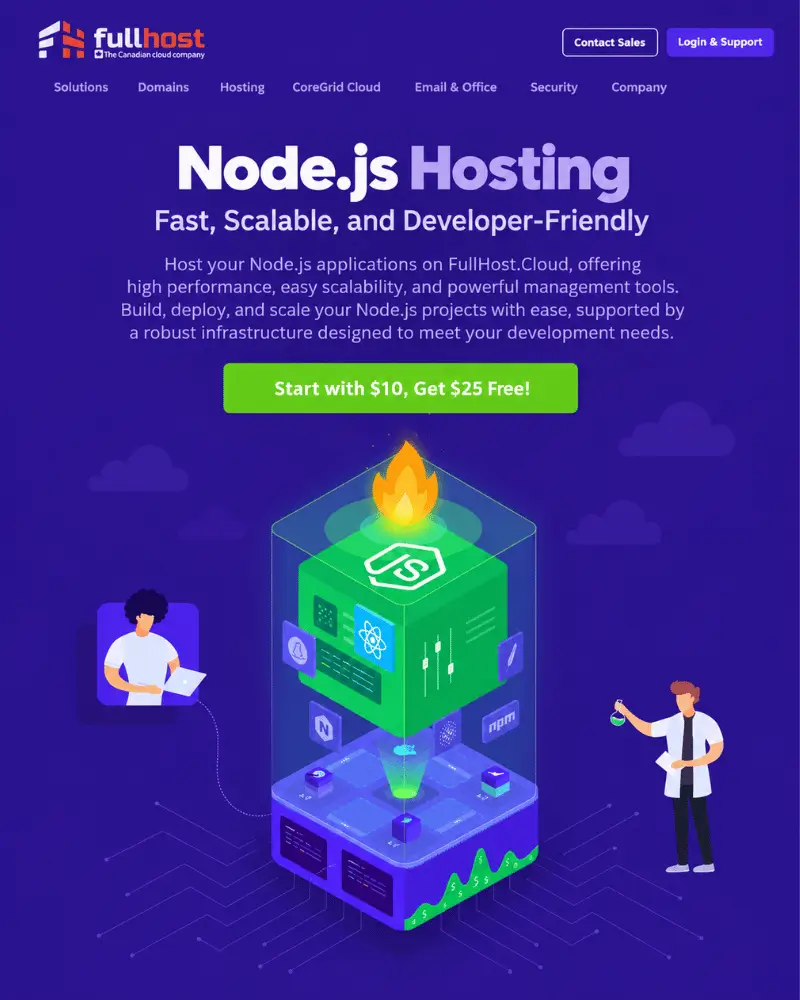
FullHost lists these Node.js management and scaling options:
- Flexible deployment: upload an application archive or deploy from a remote version-control repository, such as GitHub.
- Package-management options: use npm or switch to Yarn through environment configuration.
- Process-management tools: supported options include npm, PM2, Forever, and Supervisor.
- Automatic vertical scaling: configure an upper cloudlet limit so CPU and memory allocation can adjust with demand.
- Horizontal scaling options: add application nodes manually or configure load-based triggers.
- Environment control: isolated containers, SSH, custom domains, SSL options, and public IPv4 or IPv6 where configured.
Compare these tools alongside deployment location, backup coverage, billing terms, and the application support included in the service.
Check the current software-stack list for available Node.js versions rather than relying on a static version list in a screenshot. Include reserved resources and storage, backup, or traffic charges when estimating your bill.
Canadian PaaS alternatives, Vercel and data residency
A convenient deployment workflow is only part of choosing a host. Canadian businesses also need to understand where data lives, who controls the service, and what happens to the bill when exchange rates change.
If you are researching a Vercel alternative with Canadian data residency, separate three questions:
- Where does the application run? Check the specific compute region, not just a global map.
- Where does the rest of the data go? Include databases, backups, logs, analytics, build systems, and connected services.
- Who operates and can access those systems? Ownership, contracts, subprocessors, and support access matter alongside geography.
Vercel added a Montréal compute region (yul1) in January 2026. That means it can be an option when selecting Canadian execution for supported functions, although you still need to check databases, build systems, logs and other services separately. Render’s published deployment-region list currently has no Canadian application region. Compare products and selected regions, not only company headquarters. Vercel region documentation and Render region documentation provide the current published options.
USD billing adds a variable to a Canadian budget: the CAD amount can change even if the USD invoice does not. CAD billing removes that conversion step, although usage charges, taxes, and provider price changes can still affect your total.
Canadian data residency and sovereignty are different questions. Our data residency versus data sovereignty guide explains why a Canadian location does not automatically establish Canadian control.
A Canadian server location does not, by itself, remove foreign legal exposure. The US CLOUD Act addresses data in a covered provider’s possession, custody, or control, including data stored outside the US. The US Department Of Justice’s CLOUD Act resources explain the framework.
That does not mean unrestricted access. Canadian ownership is not a blanket exemption from every foreign law. Assess corporate structure, contracts, subprocessors, and applicable obligations.
Canadian data residency, PIPEDA and Quebec Law 25
“PIPEDA-compliant Node.js hosting” and “Québec Law 25 cloud hosting” are useful starting points for research. They are not certifications you can infer from a Canadian flag on a hosting page.
What PIPEDA Means For Your Hosting Decision
The Office of the Privacy Commissioner’s guidance on third-party service providers explains that organizations covered by PIPEDA remain accountable for personal information under their control, including when a third party processes it. Contracts and due diligence still matter even if the app runs on Canadian servers.
Ask what information is processed, who receives it, which safeguards apply, and what the provider agrees to in writing.
What Québec Law 25 Adds To The Conversation
Under Québec’s private-sector privacy law, section 17, communicating personal information outside Québec requires a privacy impact assessment. The provision also addresses entrusting certain processing to parties outside Québec. See also HostScout’s Quebec Law 25 cloud hosting guide for a more detailed examination of interprovincial processing.
A Toronto or Vancouver deployment is Canadian but outside Québec. A Montréal deployment may help with a Québec-focused location requirement, yet backups, external tools, and access arrangements still need review.
- Montréal: verify Québec deployment, storage, and backup options.
- Toronto: verify the specific product’s Ontario availability.
- Vancouver: check western Canadian deployment options and where related services run.
PaaS vs. VPS vs. shared hosting: what changes?
A VPS is a virtual server. PaaS is an application-platform model. cPanel is a control panel that can be used with shared hosting or a VPS. A VPS can run cPanel, and managed shared hosting can also support Node.js, so these categories overlap. Compare the actual plan limits rather than assuming cPanel is always unsuitable for applications.
- Shared Hosting / cPanel: convenient for straightforward websites, but modern applications may encounter restrictions on runtimes, background processes, ports, or deployment tools. Shared hosting is not inherently insecure.
- Unmanaged VPS / IaaS: typically gives administrator-level control. You handle operating-system updates, web-server configuration, monitoring, and scaling design. Automation is possible, but you must arrange it.
- Managed PaaS: abstracts more platform work. Container environments, Git-based deployment, and autoscaling are available on some platforms. They are not universal features or promises of instant capacity.
| Question | Shared Hosting | Managed PaaS | Unmanaged VPS |
|---|---|---|---|
| Starting Point | Hosting account | Application environment | Virtual server |
| Server Administration | Host manages shared server | Provider manages more platform work | Your team manages it |
| Runtime Support | Plan-dependent | Supported stacks or images | What you install |
| Deployment | Uploads or included tools | Supported Git or image workflows | Your chosen workflow |
| Scaling | Usually a plan upgrade | Platform tools and automation | Your resizing and orchestration |
| Main Trade-Off | Simplicity versus flexibility | Less administration versus constraints | Control versus operational work |
Where PaaS can make a real difference
Focus on your application
Spend less time assembling the runtime environment and more time improving your software.
Deploy with a process
Use supported workflows instead of repeating manual setup for each application release.
Respond to changing demand
Adjust limits or configure scaling where supported. Test before relying on it during a spike.
Choose around your needs
Compare Canadian regions, support, data handling, and billing alongside deployment features.
The strongest reason to move is a real problem: recurring server work, inconsistent deployments, or capacity planning that takes too much time. A basic website that already runs comfortably may not need the extra moving parts.
What is a cloudlet in elastic hosting?
A cloudlet is a small unit of resource allocation used in the Jelastic/Virtuozzo ecosystem, not a universal measurement across every PaaS.
Virtuozzo’s cloudlet documentation defines the unit as 128 MiB of RAM and 400 MHz of CPU. Small units allow finer adjustments than choosing only between a few large server sizes.
- Reserved cloudlets: baseline capacity charged according to reservation terms, including when actual use is lower.
- Dynamic cloudlets: additional allocation that changes with demand within configured limits.
- Vertical scaling: changes resources available to an existing instance.
- Horizontal scaling: changes the number of instances; automation requires configuration.
As the platform pricing documentation explains, reserved and dynamic resources have different billing roles. Pay-as-you-use cloudlet pricing does not mean every idle cost disappears.
Can you host Next.js, NestJS and WebSockets in Canada?
A Canadian platform with suitable Node.js or container support can be a candidate. Compatibility depends on the application and service capabilities, not just the PaaS label.
- Next.js hosting in Canada: check Node.js versions, build and start commands, caching, image processing, and persistent files.
- NestJS hosting in Canada: check long-running processes, environment variables, workers, database access, and graceful restarts.
- WebSocket hosting in Canada: confirm connection upgrades, idle timeouts, load-balancer behaviour, and reconnects after scaling.
For multiple instances, decide how sessions and shared state work. Deployment success is only the first test; background jobs and recovery matter too.
- Next.js: Confirm SSR, image handling, framework adapters and caching support for the required deployment mode.
- NestJS and workers: Check always-on processes, queues, background jobs and graceful shutdown.
- WebSockets: Ask about load-balancer connection upgrades, timeouts and session coordination.
- Data residency: Ask for written locations covering compute, database, backups, logs and support access.
Finding Jelastic and PaaS providers in Canada
Jelastic/Virtuozzo-based services are worth investigating for elastic application hosting with Canadian deployment options. The platform documentation covers supported technologies, architecture, and operations.
For site owners comparing managed application platforms, our Canadian cloud PaaS hosting comparison is the place to review providers side by side as that directory develops. You can also use HostScout’s hosting-location checker to investigate where a public-facing service resolves. A public IP lookup does not establish where private databases or backups operate.
If Canadian ownership is part of your shortlist, I would start with our directory of Verified Canadian-owned web hosting, then check which providers offer the platform, locations, and support your project needs.
- Deployment regions: actual selectable locations for the application and database.
- Ownership and operations: who owns the business and operates the infrastructure.
- Currency and usage: CAD or USD, reserved resources, dynamic rates, and additional fees.
- Support boundaries: platform troubleshooting versus debugging your code.
- Backups and exit options: retention, restore steps, and exporting files, data, and configuration.
The platform name alone is not enough to compare providers. Confirm the region available to the specific product you are buying instead of relying on a general company data-centre list.
A practical Canadian PaaS migration checklist
- Inventory Your Application.List runtimes, databases, uploads, scheduled jobs, email, workers, and external services.
- Map Your Data Locations.Include compute, databases, backups, logs, support access, and integrations. Assess Québec-specific requirements where relevant.
- Confirm Features And Costs.Verify framework support, persistent processes, scaling, billing currency, baseline charges, and extras.
- Deploy A Staging Copy.Test logins, forms, uploads, payments, scheduled tasks, and real-time connections. Prevent tests from sending customer messages or taking live payments.
- Test Recovery And Rollback.Verify a restore, keep a known-good backup, and plan how to return to the old environment.
- Monitor After The Move.Watch errors, response times, resource usage, and billing. Refine allocations using actual workload data.
Frequently Asked Questions
Is There A Canadian Alternative To Heroku Or Render?
Yes. Canadian application-platform providers are worth comparing for supported runtimes, Git deployment, and Canadian hosting. FullHost is one option to investigate. Verify current regions, billing currency, and framework requirements directly; not every app migrates without configuration or code changes.
Can I Host Next.js, NestJS, And WebSockets On A Canadian PaaS?
Potentially, yes. Choose a compatible Node.js runtime or container service and confirm build commands, persistent processes, connection upgrades, load-balancer timeouts, and shared-state requirements.
What Is A Cloudlet In Elastic Cloud Hosting?
In the Jelastic/Virtuozzo model, a cloudlet represents 128 MiB of RAM and 400 MHz of CPU. Reserved allocation supplies a baseline; dynamic resources adjust with demand within configured limits. Other billable services still affect your total.
Is Canadian Node.js Hosting Automatically PIPEDA-Compliant?
No. Compliance depends on the complete data-handling arrangement, including safeguards, access, contracts, retention, and processors. Your organization remains accountable for personal information transferred for processing.
Does Québec Law 25 Require Every Website To Use A Montréal Data Centre?
Not as a blanket rule. Québec’s private-sector law requires a privacy impact assessment before communicating personal information outside Québec and addresses certain processing entrusted outside Québec. Assess actual data flows and applicable obligations.
Is PaaS Cheaper Than A VPS For A Canadian Business?
It depends on workload and included services. Compare compute, storage, traffic, backups, licences, support, administration time, and currency. Usage-based pricing is not a promise of a lower invoice.
Do I Still Need cPanel With PaaS?
Usually you use the platform’s own interface instead. Confirm how domains, email, databases, files, and certificates are handled. Mailboxes and transactional email may be separate services.
Does Autoscaling Guarantee My Application Stays Online?
No. Availability also depends on application health, databases, dependencies, redundancy, and recovery procedures. Scaling capacity is one part of a resilient service.
The bottom line
PaaS earns its place when it removes platform work you do not want and gives your application deployment or scaling tools it will actually use.
For a Canadian business, add location, ownership, contracts, access, and currency to that comparison. Choose around your workload and obligations, not just the hosting label.
Ready to test a Canadian PaaS?
Stop wrestling with cPanel limits and unpredictable USD infrastructure bills if they are getting in the way of your application. Compare the requirements and choose a deployment you can actually verify.
Start with our Canadian cloud PaaS hosting guide, then explore FullHost Cloud PaaS Hosting to see how its Canadian-owned platform and Node.js environment stack up against your deployment needs.
Explore FullHost Cloud PaaSSome provider links may earn HostScout a commission. This does not affect the price you pay.